
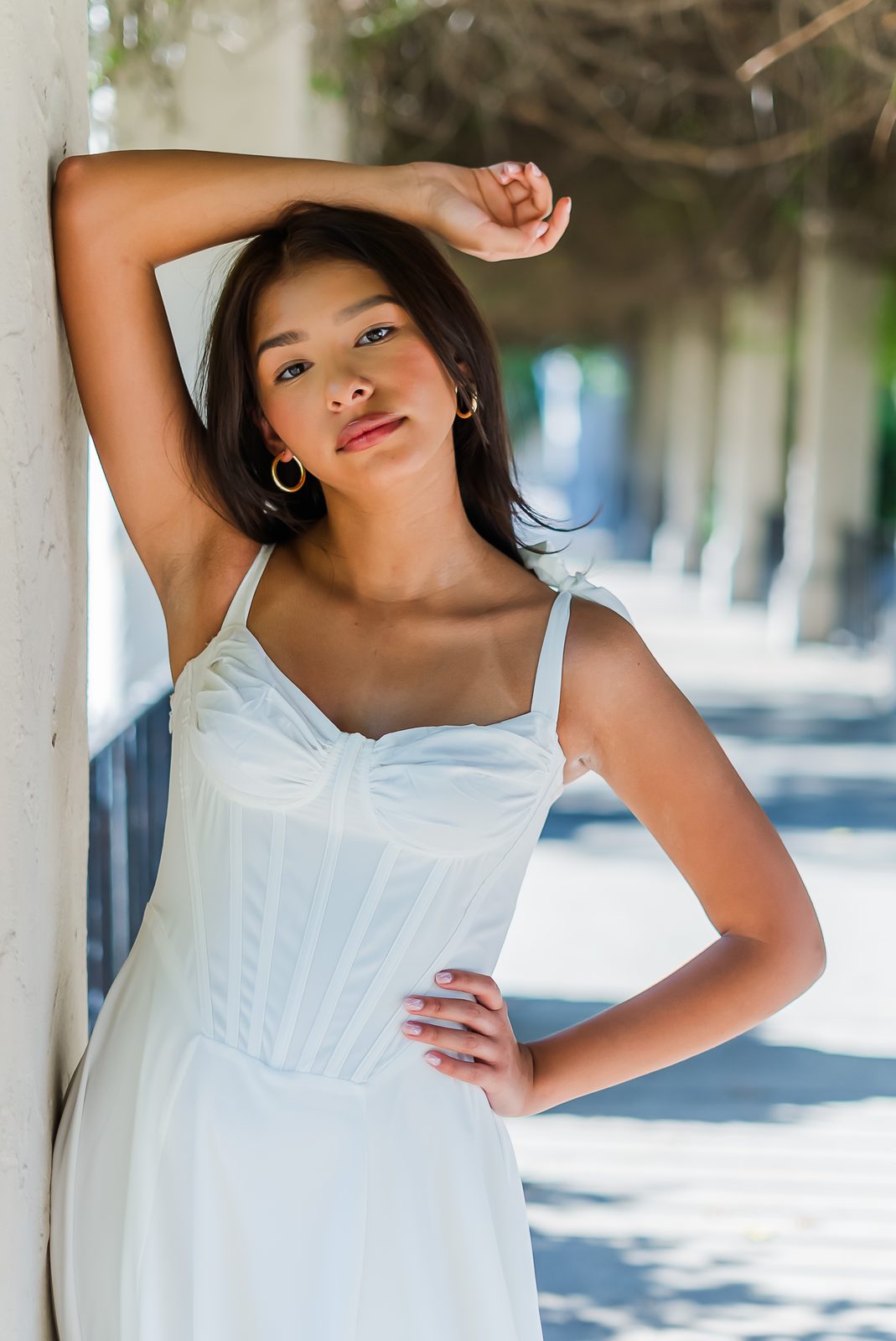
Hands are the part of the body nobody thinks about until a camera comes out. Then they turn into two heavy objects you are suddenly in charge of, and every option feels wrong.
If you have ever said “I never know what to do with my hands in photos,” you have plenty of company. Figuring out what to do with your hands in photos is also one of the easiest things to fix. There is one rule, and a short list of jobs that satisfy it.
Why Hands Go Wrong the Second a Camera Comes Out
In normal life your hands are always doing something. They hold a phone, push a cart, open a door. You never think about them because they are busy.
A photo removes the busy. Someone says “stand there,” you stop moving, and for the first time all day your hands have no task. That is the real problem behind the question. Idle hands look idle, and idle reads as awkward.
The second layer is nerves, and nerves go to the fingers first. A person can hold a relaxed face while their knuckles are white, and the camera sees the knuckles. So the fix has to do two things at once: give the hands a reason to be where they are, and take the tension out of them.
The Only Rule: Give Each Hand a Job
Every hand in the frame needs a reason to be there. That is the whole rule. Holding something is a job. Resting on something is a job. A pocket is a job. Hanging at your side with nothing to do is not, and the viewer can tell.
The job can be tiny. A thumb hooked in a belt loop is enough. The hand does not have to look busy, it just has to look like it chose to be there.
Look at the photo at the top of this post: one arm up along the wall, the other hand on the hip. Two hands, two jobs, done.
The Jobs That Work Almost Every Time
One Hand in a Pocket, Thumb Out
This is the workhorse. One hand slides into a front pocket and the thumb stays outside, resting on the fabric. The thumb matters: a hand that disappears completely makes the arm look like it ends at the wrist.
Hold Something Real
A coffee cup, a jacket over one shoulder, a bouquet, a kid, a dog leash. Objects give hands a purpose and give you something to react to.
The thing has to belong in the scene. A senior holding the football they actually play with looks right. A senior holding a prop somebody handed them two minutes ago looks like exactly that.
Touch Something
If there is nothing to hold, touch. A wall, a railing, the back of a chair, a collar, your own forearm, your partner’s shoulder. Touching gives the hand a destination and takes weight off the arm, which is why it reads as relaxed.
Light contact beats a grip. Fingertips on a wall, not a palm pressed against it.
Hair and Face: Natural Touches Versus Nervous Ones
Hair and face touches are risky because the natural version and the nervous version look identical in the mirror and completely different on camera.
The natural version has motion in it: tucking hair behind an ear, a hand brushing the jaw on the way somewhere else. The nervous version is static. A hand parked on the cheek, fingers covering the mouth, a palm cupping the chin like a school photo from 1994. Touch your hair as an action, not a pose, and let the camera catch the middle of it.
When in Doubt, Walk
Walking solves hands better than any pose, because walking gives every limb a job automatically. Arms swing, hands open, shoulders drop.
Say you are standing in a field at golden hour and nothing is working. Walk ten steps away and ten steps back, and the frames from the walk back will beat the ones where you stood still. That is why so many good photos look candid when they were not. Somebody just said “walk toward me.”
What to Do With Your Hands in Group Photos
Group photos fail on hands more than any other kind, because five people in a row produce ten hands with nothing to do.
The fix is to connect. Each person touches the person next to them: a hand on a shoulder, an arm around a waist, a hand resting on a kid’s chest from behind. Everyone ends up with at least one hand accounted for, and the group stops looking like a lineup and starts looking like people who know each other.
The person on each end has a free outside hand, so give that one a job too: a pocket, a hip, the back of a chair.
Couples: Where the Hands Go and the Spots to Avoid
Couples have the easiest job on this list because the other person is the prop. Hands go on each other, almost anywhere above the waist and below the neck: the back, the chest, the forearm, a hand on the side of a face.
Two things to avoid: both people wrapping both arms around each other’s waist, which hides four hands, and the hand around the back of the neck, which reads as a headlock. Keep the touch light and keep at least one hand visible on each person.
If you are holding hands, loosen the grip. Interlocked fingers crushed together show every tendon. Fingers loosely folded over each other show two people who are comfortable.
Where Your Hands Go in Wedding Photos
Wedding photos have three hand problems worth solving in advance.
Bouquet height: hold it at your hip bones, elbows soft, not up at your chest. A bouquet carried high hides the dress and pushes the shoulders up. Low and relaxed shows the waistline and the flowers both.
The ring hand: when you want the ring in the frame, the left hand goes on top of something (your partner’s hand, the bouquet, your own forearm) with the fingers soft and slightly angled toward the camera. Stiff, spread fingers aimed at the lens look like a hand-model audition.
The groom’s pockets: one hand in a trouser pocket with the thumb out, the other adjusting a cuff, buttoning the jacket, or on his partner. Both hands in pockets all day is why so many groom portraits look alike, so vary it.
For Men: The Fig Leaf, the Fist, and the Thumb Hook
For men, the honest answer is that most of you have three defaults and two of them are bad.
The fig leaf is both hands clasped in front at belt level, the stance of every security guard and groomsman in history. It closes the body and rolls the shoulders forward. The fist is what a nervous hand does at the side: it curls, the knuckles go tight, and the arm looks braced for something.
The thumb hook is the good one. Thumb in a front pocket or hooked on a belt, fingers resting loose on the outside. It keeps the chest open, drops the shoulders, and gives the hand a shape. Pair it with the other hand holding or touching something and you are done. If you want one more option, fix your watch. Hands adjusting a watch or a cuff always look like they have somewhere to be.
For Women: Soft Hands, Never Flat Palms
What makes a hand look elegant on camera is not the angle of the arm. It is the fingers. Soft hands means the fingers are slightly separated, slightly curved, and relaxed, with the pinky side of the hand turned toward the camera more often than the palm.
A flat palm pointed at the lens is the enemy. It is the biggest, brightest, least flattering surface a hand has, and it drags the eye straight to it. Hand on a hip? Turn it so the edge faces out, not the palm. Hand on a shoulder? Fingers together, curved, resting, not pressed flat like a stamp.
Headshots: Let Your Shoulders Do the Work
In most headshots the hands are not in the frame, which sounds like a relief and is actually a trap. Hands still affect everything above them. A fist at your side pulls the shoulder down. Hands jammed in pockets roll the shoulders in. The camera sees the result even when it cannot see the cause.
So give your hands a job out of frame anyway: rest them on your thighs or hold the edge of a stool. Then let the shoulders and arms carry the pose. Angle the body slightly, bring one shoulder a touch toward the camera, and lean in an inch from the waist.
The Short List of Things to Stop Doing
The death grip, on anything: a bouquet, a railing, your partner, a coffee cup. Tension in the hand shows before tension anywhere else.
Both hands in pockets. One pocket is a job. Two is hiding.
Fingers splayed wide, especially on a hip or a stomach. Spread fingers look like a starfish and make the hand the subject of the photo.
Hands pressed flat on the thighs when you are seated. Rest them on your knees instead, one slightly higher than the other.
And the quiet one: holding a pose too long. Any hand position, no matter how good, goes stiff after about five seconds.
Why the Fix Is Movement, Not Placement
That last point is the real secret. People hunt for the right place to put their hands, and the answer is almost always to move them instead.
A hand that is going somewhere looks natural in every frame along the way. A hand that has arrived and is waiting looks posed within seconds. So reset constantly. Tuck the hair, then let the hand fall. Pocket, out, pocket. Walk, stop, turn. The photographer’s job is to catch the good frame in the middle of the motion, and the motion is what makes the hands look like yours.
If someone says “that’s great, hold it,” count to three and then move a little anyway. The first frame after you move is usually the best one.
How We Handle Hands at a Portrait Session
None of this should feel like homework. At our senior portrait sessions around Nashville we do the directing, and it mostly sounds like “walk to me,” “hand in the pocket, thumb out,” and “touch the wall, lighter.” The session is about two hours with two looks, shot on location rather than in a studio, $700 flat with the full gallery included.
We keep it unhurried on purpose. Hands relax at the same speed faces do, and that takes a few minutes, not a few seconds. The same ideas run through our family sessions and the handful of weddings we film each year.
If you have a session coming up and want to talk it through first, reach out and we will tell you exactly how it runs.