
Is a wedding videographer worth it? The honest answer, from a company that films them: not for everyone. There are weddings where video is the wrong place to put the money, and we will tell you which ones. But for most couples asking the question, the answer is yes, and the reason is not the one the brochures lead with. It is not the drone shot. It is the sound.
Say you are six months out. The photographer is booked, the venue is paid, and video is the line on the spreadsheet you keep pushing to next month. You would like someone to tell you straight whether it matters, instead of selling you a package.
So this is the straight version: when it is not worth it, when it is, what good coverage costs, and what to pay for first if the budget is tight.
The Real Question Hiding Behind This One
Nobody wants “a wedding video.” What people want is to be able to go back. Ten years from now, when the day has blurred into a few bright moments, they want something that puts them back in the room. So the question “is wedding videography worth it” is really “will I want to go back, and will photos be enough to take me there?”
Photos are a very good answer to that. They are also a silent one. A photo of your grandfather laughing during the toasts is wonderful. It does not give you his laugh. That gap is the whole decision, and it deserves more thought than “we probably should” or “it is too expensive.”
The honest answer to “do I need a wedding videographer” is no. Nobody needs one. The better question is whether you will want one later, when you cannot go back and get it. The rest of this post is about that.
When a Wedding Videographer Is Not Worth It
We would rather lose a booking than talk someone into something they do not need. Skip it in these three situations.
The Budget Is Tight and Photos Come First
A great photographer and no videographer beats a mediocre photographer and a mediocre videographer every time. Photos get printed, framed, mailed to relatives and hung in hallways. If paying for video means cutting your photography down to the cheapest option, do not do it. Protect the photos.
You Are Eloping and the Whole Point Is No Crew
Some couples want a ceremony with two witnesses and nobody holding a camera. That is a legitimate choice and often a beautiful one. A videographer in that scene changes it, however quiet they are. If the appeal of your elopement is that nobody is watching, do not hire someone to watch.
You Know You Will Never Watch It
Some people do not rewatch things. They do not look through old photos either, and that is fine. If you can honestly see the film sitting in a folder for a decade untouched, trust that about yourself.
One caveat on that last case: the person who never watches it is often not the person who misses it. Parents watch. Kids watch, eventually. Think about who else the film is for before you decide it is for nobody.
What Video Gives You That Photos Cannot
Start with the vows. Not the vows you wrote, which you will keep in a drawer, but the vows as they actually came out: the pause where your voice caught, the word you skipped, the laugh from the second row. You will not remember them that way. Video does.
Then the toasts. A toast is a one-time performance by someone who loves you, often someone who is terrified of public speaking and did it anyway. The joke that landed. The sister who could not get through the last line. Photos of a toast are photos of someone holding a microphone.
Then the sound of the day itself. Wind in the trees during the ceremony, the band finding its groove at ten o’clock, the room going quiet before the first dance, a grandparent laughing at the kids’ table. A wedding is one of the few days of your life that comes with its own soundtrack, and the only way to keep it is to record it.
And movement. The walk down the aisle is a sequence, not a frame. The first dance is a minute and a half of two people moving together, and no single still can hold it. Photographers are brilliant at the decisive moment. Video is for everything between the decisive moments.
The Regret Is Almost Always the Audio
There is a common pattern among couples who skip video, and it is a specific one. They rarely regret not having footage of the cake or the table settings. The photos cover that. What they wish they had is the audio: the vows in their own voices, a parent’s toast, the way the officiant said their names.
We will not put a number on that, because we do not have one. It is a general observation, and you can test it yourself. Ask married friends who skipped video what they would do differently, then ask friends who have a film when they last watched it. The answers tend to line up.
The reason is simple. For most of us, memory holds images reasonably well and voices badly. A film is the only thing on your vendor list that keeps them.
How Much Is a Good Wedding Videographer?
Our prices are published, so we will use real numbers. Elopements and shorter days are $2,000: a shorter day for us and a shorter edit, but still a real film. All-day coverage is $3,500 and includes a full-length highlight film. That is the number for most weddings.
We do not sell hour packages. All-day means morning through the end of the night, and that is on purpose. The last hour of a wedding is often the best footage of the day: the dance floor has loosened up, the speeches are done, and the people still there are the people who matter most to you. An eight-hour package that ends at nine o’clock cuts the film off right before the good part. We would rather be there for all of it.
Delivery is six to eight weeks. We would rather say eight weeks and deliver than promise three and go quiet. A highlight film built on the real audio from the vows and toasts takes time to cut well, and rushing it is how you end up with a montage set to music instead of a story.
In the wider market, a good wedding videographer in most mid-size U.S. cities lands somewhere in the low to mid thousands for a full day, and the price climbs with a second shooter and extra edits. Be careful at the bottom of that range. When all-day coverage is suspiciously cheap, what got cut is usually the edit, and the edit is half the job.
If Money Is Tight, Prioritize the Ceremony and the Toasts
Do not start with the drone. Drone footage looks impressive on a demo reel and matters least when you are watching your film in ten years. If the budget forces a choice, choose in this order.
First, the ceremony with clean audio. That means a microphone on the officiant or on the groom, not a camera on a tripod at the back of the room hoping to catch the vows through the air. Vows recorded from thirty feet away in a room full of people are one of the most common reasons a wedding film disappoints. If a videographer cannot explain how they capture ceremony audio, keep looking.
Second, the toasts. Same rule. A feed from the DJ’s microphone or a recorder next to the speaker, so the words are the words.
Third, the first dance and the parent dances, because of the movement. Then getting ready, then details, then the exit. The drone is last, and a windy or rainy day will ground it anyway.
If a shorter day gets you someone who does the first two things well, take the shorter day. A short day that includes the vows and toasts with clean sound is worth more than a long one with a microphone on nobody.
What to Ask Before You Book
You do not need a long list. Ask who will actually be behind the camera on your day, and watch that person’s full films, not the studio’s reel. A reel is the best three seconds from thirty weddings. A full film shows you whether the audio was handled with care and whether the story holds together.
Ask how many weddings they take in a year. Ask what “all day” means in hours, and what time they leave. Ask how they record ceremony audio, and what the backup is if the recorder fails. Ask when you will have the film, and whether that date goes in the contract.
We wrote a longer guide to hiring a wedding videographer without regret that covers contracts, deposits, insurance and the rest. The short version: the answers you get about audio and delivery will tell you most of what you need to know.
Rain Does Not Cancel the Film
Couples sometimes talk themselves out of video because they are afraid of bad weather. If it rains, the thinking goes, the footage is ruined, so why pay for it.
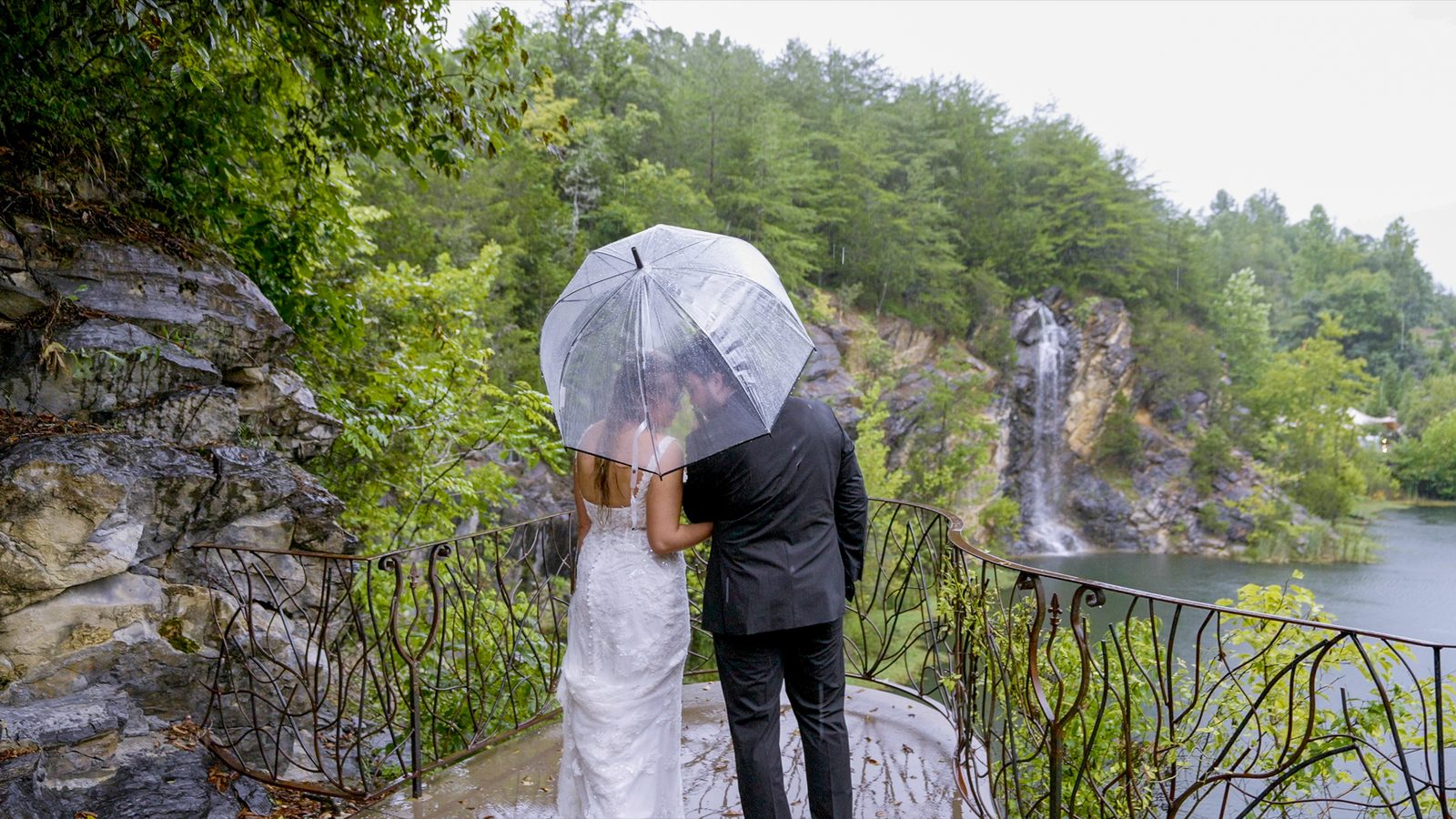
We have filmed vows in pouring rain beside a quarry lake and a waterfall, guests under umbrellas, the couple under a clear one. The rain did not ruin anything. It made the portraits better: rain gives you soft, even light, it clears the background of wandering guests, and it pulls honest reactions out of a couple instead of posed ones. The photo at the top of this post is from that wedding. The weather does not decide whether you get a film.
Any videographer working outdoors should have a plan for rain and be able to describe it: weather-sealed cameras, a covered backup spot for portraits, a bag of clear umbrellas in the car. If they get nervous when you ask, that tells you something too.
Why We Only Take a Few Weddings a Year
Most of what SDub Media does is recurring video for businesses: weekly series, podcasts, headshot days, corporate events. Weddings are a deliberately small part of that. We take a handful a year, all day, and none of them squeezed between three other jobs on the same weekend.
The person who owns the company is the one behind the camera and the one who edits the film. That is not a boast, just how it works here, and it is why the delivery window is honest and the edit gets real attention. The details, including both prices above, are on our weddings page.
If your date is one of the few we can take and you want to talk it through, reach out and we will tell you straight whether we are the right fit.